MLB Live Betting From the UK — In-Play Markets, Timing and Edge
 Available in US
The first live MLB bet I ever placed was at half past midnight on a Wednesday. The game was in the fourth inning, the starting pitcher had just been pulled after giving up back-to-back doubles, and the live moneyline on the trailing team had shifted from +180 to +135 in the time it took me to brush my teeth. I backed the trailing side, watched the bullpen settle down for three clean innings, and collected on a comeback win I’d have missed entirely if I’d only bet pre-match. That night changed how I allocate my baseball betting time.
More than 60% of all online sports bets placed in Europe are now in-play wagers — a figure that’s been climbing steadily for years and shows no sign of plateauing. In football, that dominance makes sense: 90 minutes of continuous action with tactical shifts that change the picture every few minutes. But baseball, with its stop-start rhythm and discrete at-bat structure, is arguably even better suited to live betting. Every half-inning is a natural reset point. Every pitching change reshuffles the probabilities. And 78% of global sports bets are placed from mobile devices, meaning you can track and act on these shifts from your phone while doing just about anything else.
For UK bettors, MLB live betting comes with a unique twist: time zones. East Coast games start at 11:00 or 11:30 PM BST, which is manageable. West Coast games don’t get underway until 2:00 AM or later, which means your prime live-betting window either falls during a late-night session or you’re betting blind and checking results over breakfast. Andrew Rhodes, the UKGC’s chief executive, described the current regulatory moment as “a very different situation” from what came before — and for live baseball bettors, the situation is equally distinct: you’re operating in markets that the British betting public largely ignores, which is precisely where opportunity lives.
In-Play Markets for MLB
When I tell people that MLB offers more in-play market variety than most European football leagues, they assume I’m exaggerating. I’m not. The structure of baseball — nine innings, each with distinct offensive and defensive halves, each featuring multiple discrete plate appearances — creates a natural framework for granular market design that continuous-flow sports struggle to match.
Live Moneyline
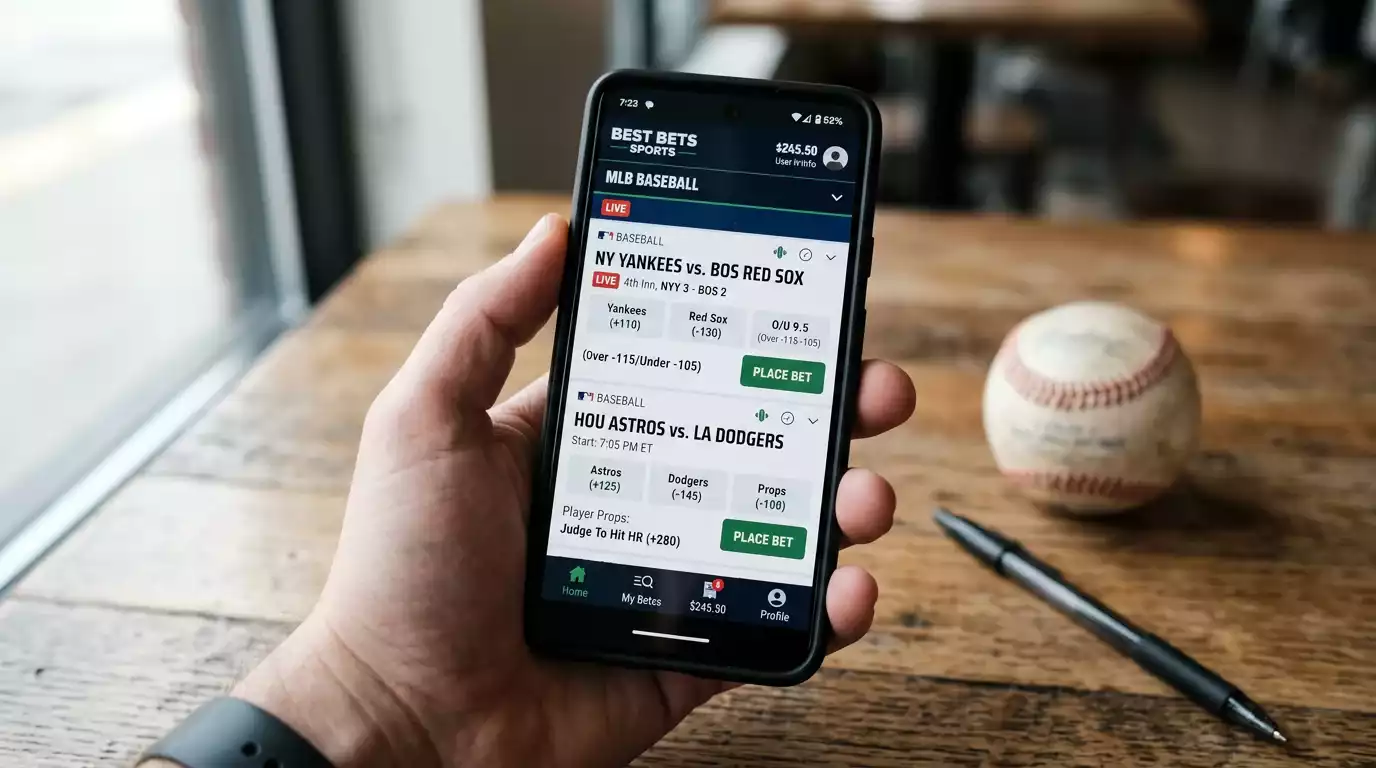
The most straightforward live market mirrors the pre-match moneyline but adjusts in real time based on the score, inning, and current matchup dynamics. A team that trailed by two runs in the third might be priced at +200 pre-game but +160 live if they’ve loaded the bases with nobody out. The live moneyline is where I place the majority of my in-play bets because it’s the most liquid, the margins are tightest, and the price movements are easiest to track against my pre-game assessment.
Live Totals
The over/under line adjusts continuously. If the pre-match total was set at 8.5 and the first three innings produced six runs, the live total might recalibrate to 12.5 for the remainder. Alternatively, if three scoreless innings have gone by, the live total may drop below the opening number. I find live totals particularly interesting when a starting pitcher exits earlier than expected, because the market’s reaction to a bullpen replacement often overestimates or underestimates the replacement’s ability based on small-sample relief appearances.
Next-Inning Markets
This is where baseball’s structure truly shines for live bettors. Next-inning winner, next-inning total runs, and next-inning run scored (yes/no) are all available at major UK-licensed operators. Each inning resets the slate: new batter-pitcher matchups, new tactical considerations, and a fresh set of probabilities. I treat next-inning bets as individual micro-events rather than extensions of the game-level bet. If I have a strong view on a specific reliever facing the bottom third of a lineup, a next-inning total of under 0.5 runs can offer excellent value at short odds.
Pitcher and Player Props
Live strikeout props, next batter to get a hit, and run-scorer markets are expanding at UK sportsbooks, though availability varies significantly. The depth of live prop coverage at a dedicated baseball operator is noticeably richer than what you’ll find at a generalist bookmaker that treats MLB as an afterthought. If live props are a priority for you, it’s worth checking market depth before committing to a single platform.
Alternative Lines
Some operators offer live alternative run lines and alternative totals — essentially the same spreads and totals as pre-match, but recalculated in real time. These are useful when you believe the market has overreacted to an early-inning scoring burst. A game that goes 4-0 in the first inning doesn’t necessarily stay lopsided; baseball is famously a game of comebacks, and the alternative live run line on the trailing side can price in a recovery at surprisingly generous odds.
I find particular value in the live alternative total when the starting pitchers have both exited early and the game transitions into a bullpen affair. Most live-totals algorithms lean heavily on the opening-pitcher matchup data, and once those pitchers leave, the model’s confidence drops. That uncertainty creates wider lines and more room for a prepared bettor to disagree with the number. If you know the bullpen matchups better than the algorithm does — and with even modest preparation, you often will — alternative live totals become one of the most exploitable markets in the game.
Cash-Out Mechanics
Cash out is available on live MLB bets at most UK operators, and it’s worth understanding even if you rarely use it. The cash-out price is always worse than the theoretical fair value of your position, because the bookmaker embeds a margin in both the original bet and the cash-out offer. I use cash out sparingly and only in one scenario: when new information — a key injury mid-game, a sudden weather change — materially alters my original thesis and I want to lock in partial profit rather than ride out a bet I no longer believe in. Using cash out to manage anxiety or lock in small wins at the cost of expected value is a habit that erodes your long-term return.
Timing Windows and Pitching Changes
There’s a moment in every MLB game that I wait for like a hawk — the moment the manager walks to the mound and signals for a reliever. The live line freezes, recalculates, and when it reopens, the market has repriced the game based on the new pitcher’s profile. That repricing window, which lasts anywhere from 45 seconds to two minutes at most operators, is where the sharpest live value tends to appear.
Here’s why. The market’s repricing algorithm is largely mechanical: it assigns a value to the incoming reliever based on aggregate statistics — ERA, WHIP, handedness. What the algorithm often misses is context. Is the reliever on a second consecutive day of use, meaning his velocity is likely down? Has he faced this lineup recently, and how did he perform? Is the game situation one where the manager is using his best arm or simply burning an innings-eater because the game feels out of reach? These contextual factors create mismatches between the live price and the true probability, and they reward bettors who’ve done the homework before the game started.
Rain Delays and Challenge Reviews
Rain delays are goldmines for patient live bettors. When play is suspended, many recreational bettors cash out or lose interest. The live line, when it reopens, sometimes reflects reduced liquidity and wider margins — but it also reflects uncertainty about how long the delay will last and which pitchers will return after the break. Starting pitchers pulled mid-game for a delay often don’t return, shifting the game to a bullpen affair. If you’ve analysed bullpen depth coming into the game, a rain delay can hand you an informational edge that the market hasn’t fully priced.
Challenge reviews — where a manager disputes an umpire’s call and the play goes to video review — create shorter pauses, but they occasionally shift the momentum of an inning in ways the live line doesn’t immediately capture. A reversed out call that extends an inning changes the run expectancy for that frame, and the live next-inning or live totals market may take a beat to adjust. I’ve found small but consistent value in the 30-second window after a challenge reversal.
Streaming Access and Information Lag
MLB.TV recorded 14.5 billion minutes of streaming viewership in 2024 — a figure that underscores how accessible live game footage has become worldwide. For UK live bettors, streaming access is essential because it eliminates the information lag between what’s happening on the field and what the odds reflect. If you’re betting in-play based solely on the scorecard and box score, you’re missing the visual cues that inform the best live decisions: a pitcher’s body language, a batter’s timing, the manager’s posture in the dugout. These aren’t quantifiable, but they matter.
The caveat is stream delay. Most legal streams run 15 to 30 seconds behind real time, and the odds feeds are faster. If you’re placing a live bet the instant you see something happen on your stream, the market may have already moved. I account for this by identifying my live opportunities during the between-innings break — when the market is static — and placing the bet before the next half-inning begins. It’s not perfect, but it reduces the impact of stream lag to nearly zero.
The Between-Innings Window
Each half-inning break lasts roughly two minutes during a regular-season game. In that window, the line stabilises, the box score updates, and you have time to assess whether the live price reflects what you’ve seen. I treat these breaks as my primary decision points. During the action, I observe and note. During the break, I decide and act. This rhythm matches the sport’s natural cadence and prevents the kind of reactive, mid-at-bat impulse betting that tends to destroy live-betting bankrolls.
The seventh-inning stretch is a particularly interesting moment. It’s the longest break in the game, managers often make their most significant bullpen moves immediately after, and the live line is priced based on whoever is currently in the game. If you anticipate a pitching change that the market hasn’t yet incorporated, the stretch is your window to act before the repricing hits.
UK Time Zone and Late Games
Let’s be honest about the elephant in the room: most MLB games are played at times that are deeply inconvenient for anyone living in the UK. I’ve accepted this as a feature of the niche rather than a drawback, but it took a while to reach that acceptance — and a few bleary-eyed Tuesday mornings where I questioned my life choices.
East Coast day games, which typically start at 5:00 or 6:00 PM BST, are the most UK-friendly. You can follow them during the evening, bet live with full attention, and still be in bed by midnight. East Coast night games push to 11:00 PM or later. Central time games add an hour. And West Coast night games — the Dodgers, Giants, Padres, Mariners — don’t throw their first pitch until 2:00 AM BST at the earliest, sometimes 2:30 or 3:00 AM.
The UK online gambling market is projected to grow at a compound annual rate of 12.8% through 2030, and part of that growth will come from expanded live-betting coverage as operators chase round-the-clock engagement. For now, though, the practical reality for MLB live betting from the UK is that you need to choose your spots. You can’t follow every game live, and you shouldn’t try.
A Tiered Approach
I divide the daily MLB slate into three tiers based on UK start time. Tier one: games starting before midnight BST. These get full live attention — I watch the stream, track the line, and place live bets as warranted. Tier two: games starting between midnight and 1:30 AM. I’ll set alerts for specific situations (pitching changes, scoring in the first three innings) and place live bets selectively if I’m still awake. Tier three: West Coast games starting after 2:00 AM. These are pre-match only. I place my bets before the first pitch, go to sleep, and check results in the morning.
This tiering system means I never sacrifice sleep for a marginal live-betting opportunity, which matters more than most people realise. Fatigue degrades decision quality, and a poorly considered live bet placed at 3:00 AM is worse than no bet at all. For a detailed breakdown of scheduling strategies, the West Coast MLB games in UK time guide maps out start times by division and offers specific approaches for managing the late-night calendar.
Live Betting Discipline
Two seasons ago, I tracked not just my live-bet results but the time of day I placed them. The correlation was uncomfortable: bets placed after 1:00 AM had a win rate 6% lower than bets placed before midnight. Same analysis, same models, same markets. The only variable was me — tireder, less patient, more prone to reactive decisions. That data convinced me to implement hard cutoffs.
Pre-Set Rules That Work
Live betting generates a dopamine loop that pre-match betting doesn’t. The constant movement of odds, the visual stimulus of a live stream, the instant feedback — it’s designed to keep you engaged and clicking. Fighting that loop with willpower alone is a losing proposition. What works is rules, written down and non-negotiable.
My live-betting ruleset: no more than three live bets per game. No live bet within 60 seconds of the previous one — this eliminates impulse doubles. No live bet if I can’t articulate in one sentence why the current price is wrong. And no live betting at all if I’ve already hit my daily loss limit on pre-match wagers. That last rule is the hardest to follow, because the temptation to “make it back” on a late-night live opportunity is powerful. It’s also the rule that has saved me the most money.
Tilt Recognition
Tilt in live betting looks different from tilt in pre-match. Pre-match tilt usually manifests as increasing stake sizes. Live-betting tilt manifests as increasing frequency. You start placing a bet every inning instead of waiting for the specific spot you identified. You switch from the live moneyline to a live prop because “something needs to hit.” You find yourself betting on a game you didn’t plan to bet on at all, simply because it’s the only one still live at 2:30 AM.
If any of those patterns sound familiar, you’re not alone — I’ve fallen into every single one. The fix isn’t complicated: close the app. Not for the night, but for at least 15 minutes. Set a timer if you need to. The urge to re-enter the market after a short break is dramatically lower than the urge you felt in the moment, and that’s all the evidence you need that the original impulse was emotional, not analytical.
Another tilt signal specific to live MLB betting from the UK is what I call “last game syndrome.” It’s 1:45 AM, your earlier bets have settled, and there’s one West Coast game still in the third inning. You had no pre-game analysis on this game and no plan to bet it. But it’s there, it’s live, and you’re awake. So you convince yourself to “just have a look” at the line, which turns into a bet, which turns into two bets, which turns into a morning where you regret not going to bed an hour earlier. The solution is the same one that works for every other form of tilt: pre-commitment. Decide before the evening which games you’ll follow live and stick to that list. If it’s not on the list, the app stays closed.
Live MLB betting from the UK is one of the most rewarding niches I’ve found in seven years of wagering. The market is less crowded than football, the structure of the sport creates natural entry points, and the time-zone challenge actually works in your favour by thinning out casual competition. But none of those advantages matter if you can’t maintain the discipline to use them properly. Rules first, bets second. Always.
Frequently Asked Questions About MLB Live Betting
Which UK sportsbooks offer the widest range of MLB live markets?
Coverage varies significantly. Operators with dedicated US sports sections tend to offer live moneylines, live totals, next-inning markets and some player props. Generalist bookmakers may only carry live moneyline and totals. Check the in-play section during an active game before committing — market depth during a live game tells you more than any promotional page.
Can I watch MLB games live while betting in-play from the UK?
MLB.TV is available in the UK and provides live streams of nearly every regular-season game. Some UK sportsbooks also offer in-app streaming for selected MLB games if you have a funded account. Be aware that stream delays of 15 to 30 seconds are common, so the odds may move before your stream reflects the latest action.
How quickly do in-play MLB odds update compared to football?
MLB live odds update at each discrete event — a pitch, an at-bat result, a pitching change, or an inning break. Between events, the line is relatively stable, which gives you time to analyse before the next movement. Football odds update almost continuously during open play. For bettors who prefer deliberate decision-making over rapid reaction, baseball’s pacing is an advantage.
Is live betting on baseball riskier than pre-match betting?
Not inherently, but the speed of decisions and the emotional pull of live action can lead to less disciplined wagering if you are not careful. The risk comes from process, not from the market itself. A well-considered live bet placed at a genuine mispricing is no riskier than a pre-match bet. A live bet placed impulsively at 2:00 AM because you are chasing a loss is far riskier.
Prepared by the Online Baseball Betting editorial staff.